
Photo taken from the Material Thinking website
I have encountered the Breath Pattern installation in Mildura near the Murray/Millewa river a number of times but had never fully understood what it represented. I knew that it was in honour of the poet John Shaw Neilson but some elements remained mysterious to me.
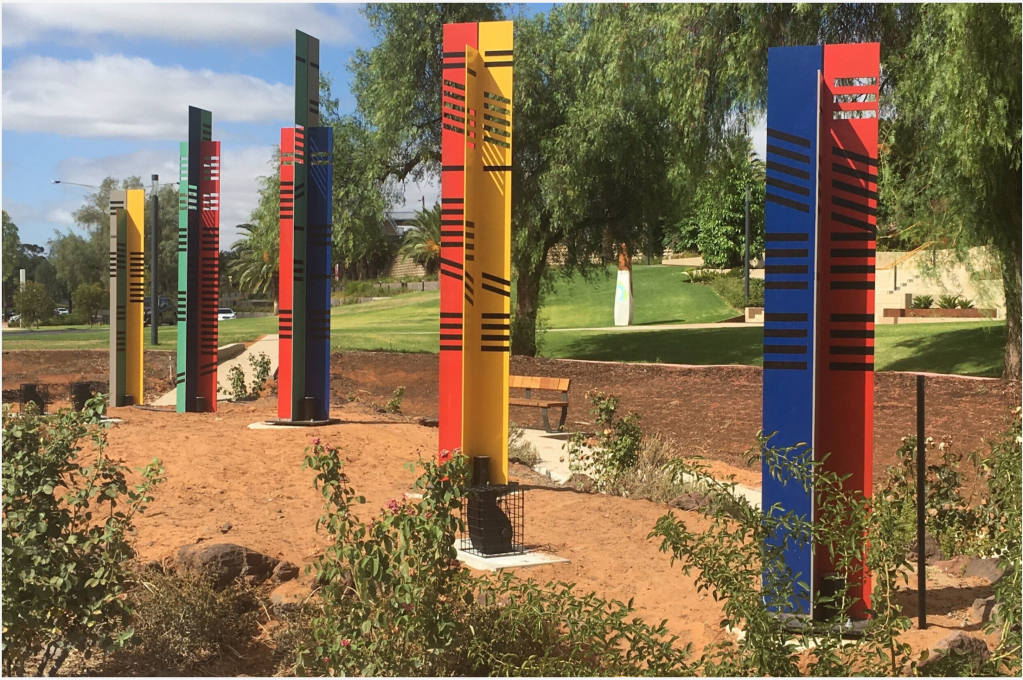
Breath Pattern is described as a ‘five element vertical sculpture with sound installation’ which was created by Paul Carter and sound artist Christopher Williams. Located in the Hyder Garden near the river, which was originally intended for visually impaired people.
They took Neilson’s comment that he was a ‘Good Celt’ and translated the poem into Ogham, an early medieval alphabet used primarily to write the early Irish language from the 4th to 6th centuries (AD), and later the Old Irish language (scholastic ogham, 6th to 9th centuries). The vast majority of the inscriptions consist of personal names- an ancient form of tagging. Ogham is still used by neo-druids and neo-pagans for divination. A divination method invented by neo-pagans involves casting sticks upon a cloth marked out with a pattern which is then interpreted – a bit like reading tea leaves?
Ogham is sometimes known as the Celtic ‘tree alphabet’ as some words have tree designations. This links nicely to Neilson’s passion for trees. I read recently that he was once asked to cut down trees for a sawmill and was found later speaking to them and refusing to carry out the job.
The brightly coloured standing forms of Breath Pattern are described as ‘stelae’ by the artists. A stele is a stone or wooden slab, generally taller than it is wide, erected in the ancient world as a monument.
The forty faces of the stelae translate the emotional magic of the poem’s lines into colours. Walking around the sculpture different colour combinations align to produce a constantly changing spectrum. This evokes the way Neilson’s poems skilfully modulate between different feelings, of wonder, of hope, of courage and sometimes of nostalgia.
It was at Chinkapook that he finally finished writing ‘The Orange Tree’. As he told biographer James Devaney, ‘I got the ideas when I was weeding oranges at Merbein. There was also something which I tried to drag in, some enchantment or other. I cannot well describe it. I have seen prints of Botticelli’s wonderful picture “Spring” – I think that is its name. It has lovers, it has maidens and greenery, and I think a robber in the background. Of course I know nothing about art at all, but anything of Botticelli’s I see fills me with emotion. Prints of other great pictures see to leave me cold.’
The poem took him about four years to write. It started in Gippsland when he was driving a horse and dray there but it was a very boggy place so he went to work amongst the oranges near Mildura. ‘Then I started to alter the old piece. I did this because I started to get rather the same ideas about the orange tree, and in the same metre. The old piece was about a different thing altogether – some idea that had first struck me in Melbourne, but I could never get properly going on it. I brought in the young girl because children have a sort of freshness about these things. It’s a sort of imagination we all lose later on. We know that from our own childhood. Everything is enchanting to a kiddie.’
‘The Orange Tree’ imagines the trees whispering. ‘There is a light, a call, a step,’ says the young girl in the poem, which can only be felt by ‘listening like the Orange Tree.’ Recognising the childhood dimension of the poem, Carter and Williams invited students from three Mildura schools to respond creatively to it so there are a lot of squawking, playful sounds when you get up close to it.
On the Material Thinking webpage, Carter explains the location of the artwork:
The poems of John Shaw Neilson evoke the sounds, scents and rhythms of the bush. The genius of Neilson (who was chronically short sighted) …will create a new relationship between the scents of the garden and the sounds associated with it. This is an extension of the garden’s ambition to engage the visually impaired emotionally, imaginatively and sensually.
It’s quite a departure from other memorials for Neilson including the cottage at Nhill that was moved from Penola which I’ve already written about and the stone N near Dow Well, the bust at the Footscray library and plaque in Gordon St here his house used to stand. I think local people can be bemused by Breath Pattern, given its seemingly cryptic nature – but if you give it some time – and do background reading, it feels like you’ve unlocked a puzzle.
 Siting Writers