
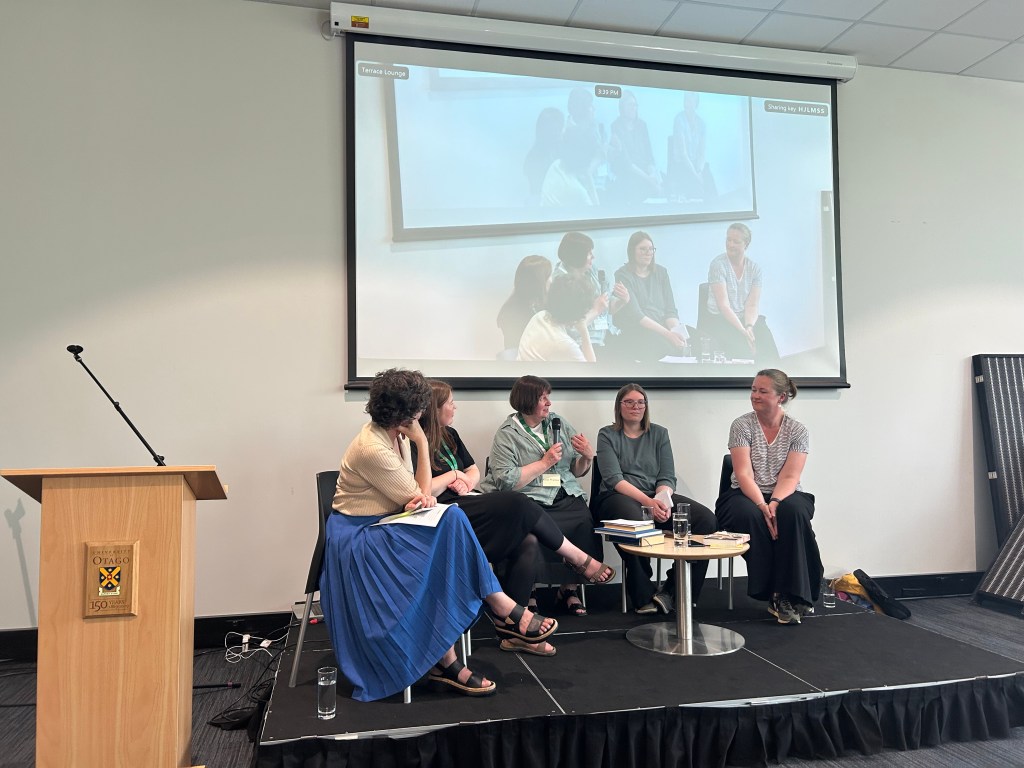
I was lucky enough to attend a session with the same name as this post at the BSANZ conference in Ōtepoti Dunedin last month. Five people with intimate knowledge of writers’ houses and residencies came together to share their thoughts during the closing session.
The moderator Karin Warnaar began by quoting W.H. Auden on Yeats’ death: ‘he became his admirers’. And then quotes Yeats himself : ‘how to tell the dancer from the dance?’ Writers’ houses are usually enabled by their admirers who have the power to present their idols in ways that best suit the contemporary context.
Warnaar introduced the panel comprising of Vanessa Manhire of the Robert Lord Writers cottage, Ōtepoti Dunedin, Chloe Seale of the Janet Frame Trust, Cherie Jacobson Manager of Katherine Mansfield House and Garden and Sue Wootten, an author who won the Katherine Mansfield Menton Fellowship in 2020 and took up residency belatedly in 2023, due to the pandemic.
Robert Lord is probably the least well known of the figures who were discussed. He was a queer Aotearoa NZ playwright who lived in New York and died from HIV AIDs complications in 1992 (HIV AIDS). His biggest play Joyful & Triumphant was performed after he died and a selection from his diaries has recently been published by Te Whare Tā o Ōtākou Whakaihu Waka/Otago University Press, edited by Manhire and Chris Brickell. The Trust was set up to provide residencies for writers to live and work, ranging from 4 weeks – 6 months. The Trust has partnerships which provide stipends for residents. Writers often say that they ‘feel like they are staying at a friend’s house’ because many of Lord’s things are still there including his library.
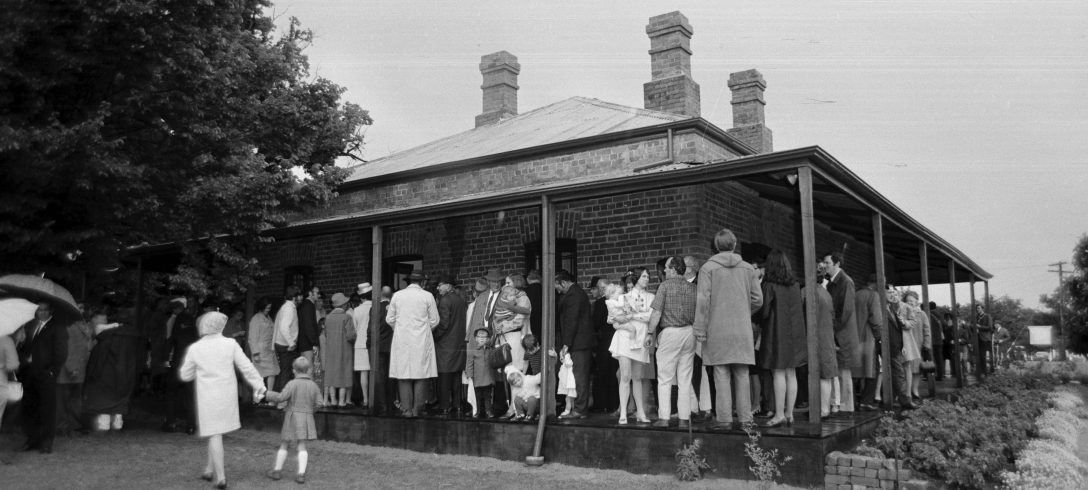
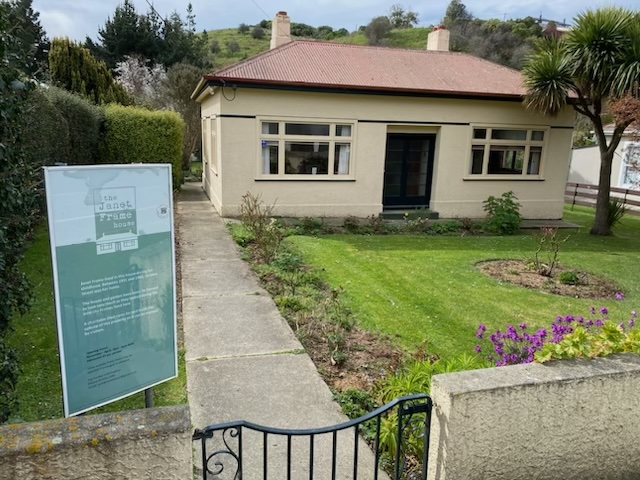
I have already written about Janet Frame’s house in Oamaru in a previous post. The Frame family moved into 56 Eden St in 1931 and lived there until she went to Teachers College in early 1940s. After this time the house continued to be a rental. it was purchased in 2002 when it was not on the market. During the process of curation, Janet and her sister June were able to advise but it’s not a slavish recreation. Chloe said that Janet didn’t want too much money put into doing that work. The house was opened in late 2003, when Prime Minister Helen Clark cut one of Janet’s old typewriter ribbons. Chloe observed that Frame wanted an imagination that could descend on 56 Eden St – this is the creative legacy she has left for young people in Oamaru.
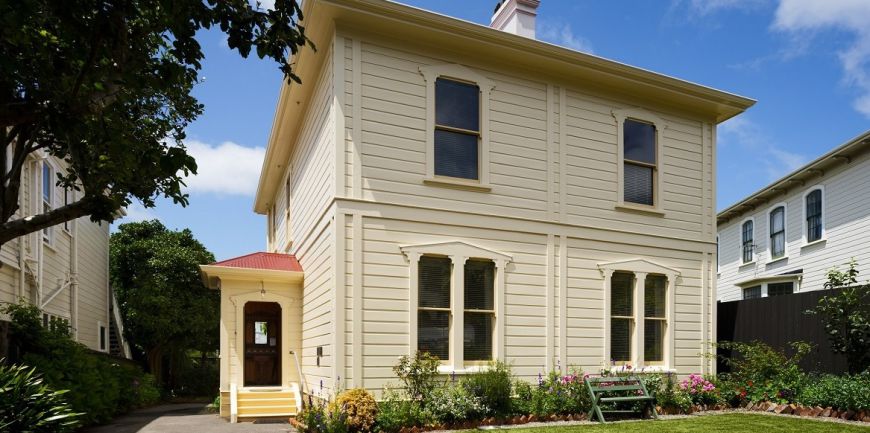
The Mansfield House and Garden (formerly the Mansfield Birthplace) is much grander in scale than 56 Eden St. Cherie reminded us that it’s a two storey wooden house that was built in 1888. Mansfield only lived there till she was 5 years old then the family moved to bigger houses around Pōneke Wellington. When the motorway cut through the city it took many houses with including the ‘Garden Party house’ which was bulldozed in 1960s.
The house was restored to its 1888 layout – a toilet in the lean-to and the bay windows were removed. Unlike other writers’ houses, it can’t host writers in residence because there’s no bathroom. Cherie described the process of restoration as ‘educated imagining’ of what the house might have looked like, full of furniture from late 1800s, early 1900s. No original manuscripts or artefacts are kept there – instead they are housed at the Turnbull Library which has the necessary safeguards and climate control. She expressed concerns about the future of the house as 40% of visitors are international and Mansfield is not compulsory in Aotearoa New Zealand schools, posing a challenge for the house as there’s a diminishing understanding of her importance.
Sue Wootten talked about her stay in the basement of the Villa Isola Bella (which might have been a lapinière or garden shed), when KM herself was in the house above. She spent a lot of her time coughing on the terrace – wrote ‘Daughters of the Late Colonel’ there – with her companion Ida Baker and visits from her husband John Middleton Murray. ‘Mouldy and dishevelled’, as Wootten put it, the room is owned by the mairie or town hall. Writers work at the chipped desk with a peeling poster of KM looking at you, along with bookcases containing a motley collection. There have been different funding sources through the years – in its heyday, you could take a whole family and go for a whole year. Janet Frame’s ‘In the Memorial Room’ (1974) describes it as a ‘mausoleum’. Wootten described a ‘midden of old items’ left by other writers including a mysterious bright pink dress.
The panellists raised the threatened status of Penman House where Robin Hyde wrote in the attic as a mental patient. A campaign by writers and publishers was launched against its demolition however the chances of success are slim.

Cherie coordinates a network of people who are associated with creative historic houses who regularly meet via zoom. All the panellists agreed that there are many properties which could be ‘saved’ but it’s difficult to fund them long term. Buying a house is relatively easy however the maintenance of the house is the most challenging part.
The writers’ sites discussed in the panel show that places are not isolated – but they are also not only repositories of stories about and by the writers – they offer connection and opportunities for people to engage with each other. All the properties are trying to find ways to encourage the community to enter and enjoy them. The Mansfield House and Garden hosts creative writing workshops for young children and a KM embroidery circle. To conclude, Warnaar suggested that there are many stories in the houses and so many different ways of accessing them. The panel agreed that people seek connection to their literary whakapapa – their writerly ancestors – and want some of their power to rub off on them.
 Siting Writers